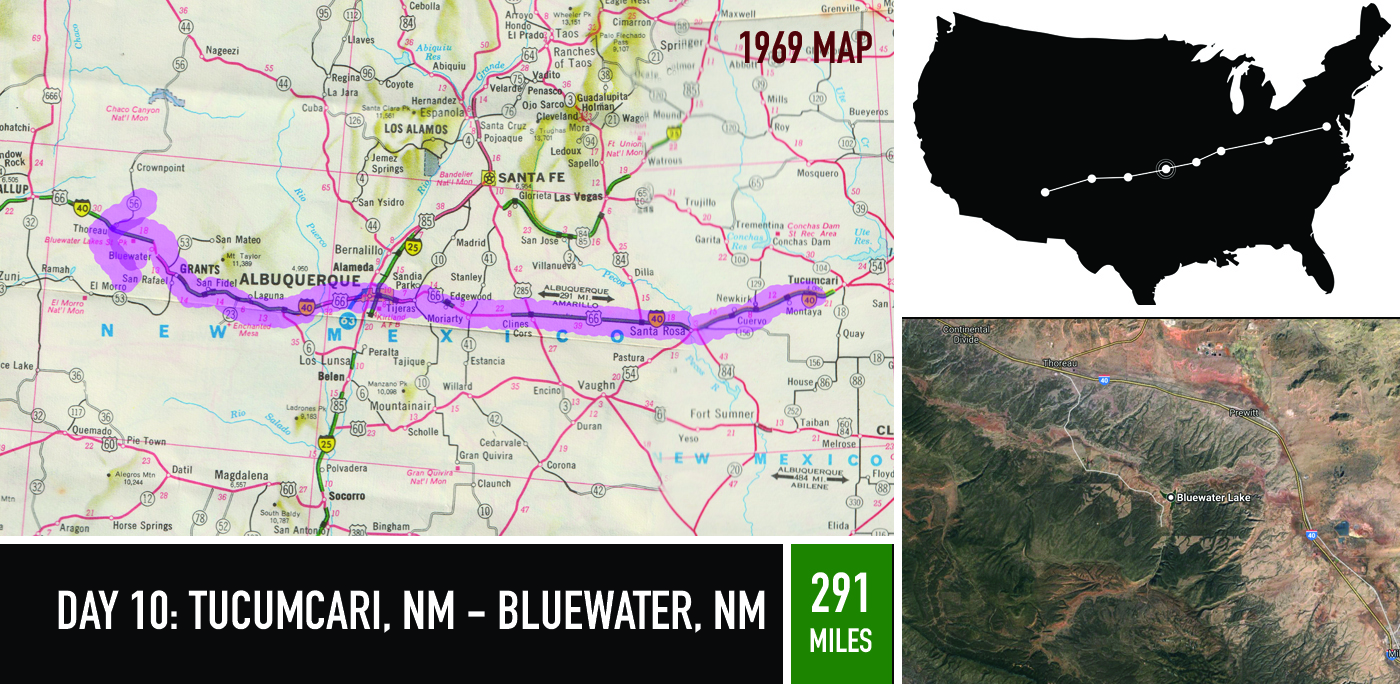
June 25, 1969: Life on the Road

I’ve long held the belief that, if you want to really know someone, travel with them. Even more so: go on a roadtrip together. Such events led to more than one breakup back in the day.

Of course, as a car- and tent-confined Family, we Binders had to coexist. Here are a few of the rules and procedures we followed, along with a few ideas from the good people at AAA.

Quiet Hour

For every hour a child stayed completely quiet, the parents would bestow 25 cents. We could use it for anything, usually candy and arcade games at the next stop. Thing is: You had to be quiet for a full hour, not 55 minutes. So as the clock ticked down to the magic moment, the boys would begin trying to sabotage each others’ progress, making faces, tickling, general intimidation. But, like I said, they were Family, so we couldn’t leave them at the next rest stop and move on.

The Pee Jar

Yes, it is what it sounds like it is. I imagine it worked because we were three boys sans modesty. It was always there, on the floor of the backseat, and when nature called we would get low and take care of business. There was an incident explained in Mom’s July 28 recollection where something bad happened to the pee jar. Boys! Amirite?

Art & Diversions

I don’t recall for certain, but I’m pretty sure Mom loaded us up with pens and paper. All three of us were budding artists (but none of us followed our bliss), so I can imagine some competitive doodling and sketching along the way. Tim was the illustrator — faces, animals, fish. Mike visualized sci-fi scenarios and architecture. I worked in long form, mixing scrawl with sketch. Like so much of this trip, the evidence is lost to the ages.

I seem to remember some “I Spy” and license plate bingo. Mom recently described some other games that I don’t recall, but they do sound plausible! Something about points for seeing cows: white cows were low scoring, black/brown better, and spotted cows were prime point sources.

Mom recently recalled that Tim would read aloud from John Steinbeck’s Travels with Charley (in Search of America) and the last of Laura Ingalls Wilder’s Little House books. We also listened to the radio in the car, whatever AM stations we could find for as long as we could keep their signal.
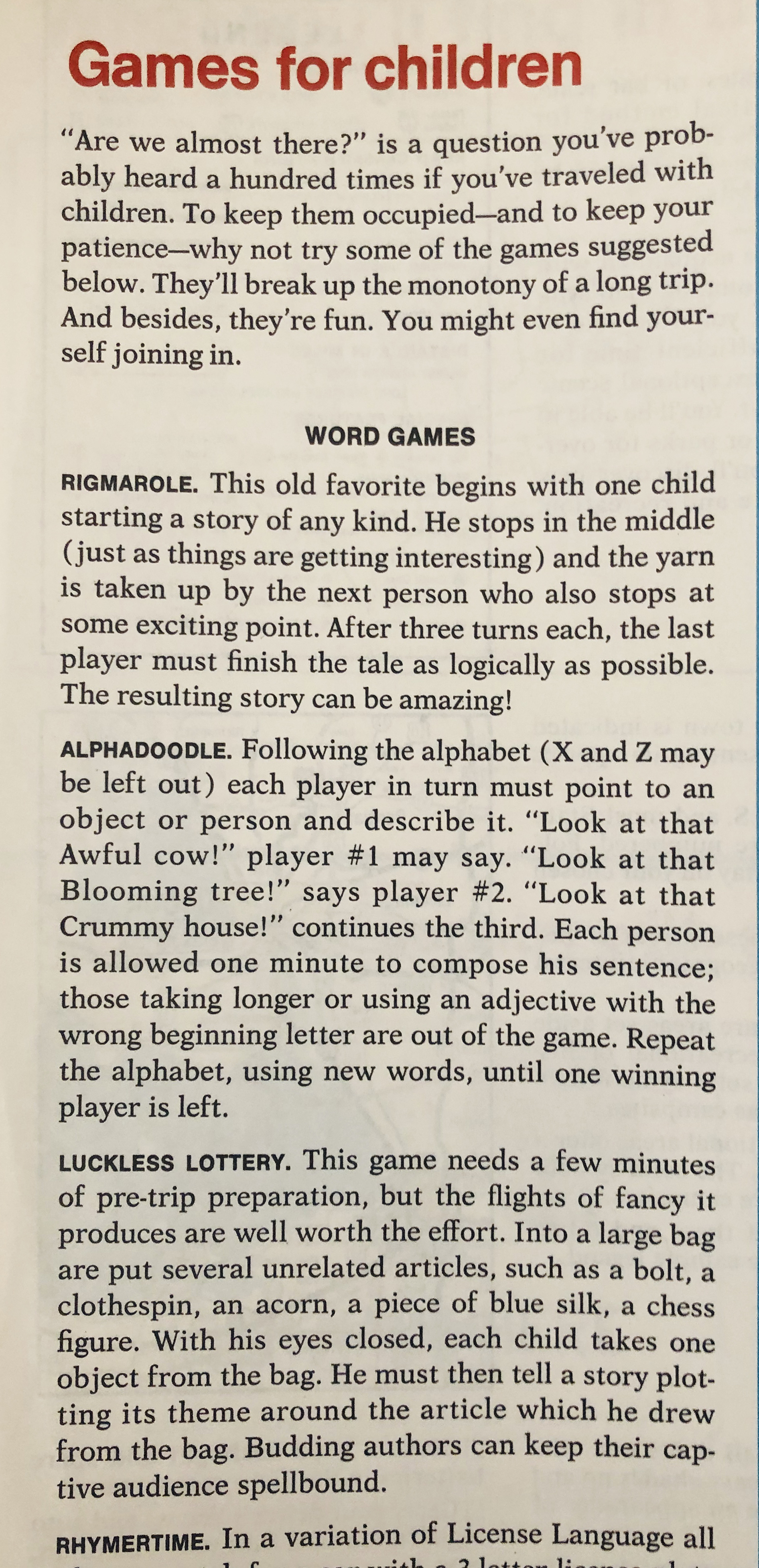
Travel Tips 1969 vs 2019

Here’s what AAA suggested families do for traveling with kids back in 1969, before video games, tablets and seat-back video screens. And phones, internets, etc. etc.

In my entire childhood, I never heard of any of these activities.

I was surprised recently when I came across this story from Travel Channel; the diversions they suggest for roadtripping with kids includes quite a few non-tech activities. Bravo!

Had breakfast at the Cattlemanโ€™s Cafe. Had a โ€œtailโ€ picnic for lunch (thatโ€™s Doug-ese for โ€œtailgate.โ€ Camped at Bluewater State Park in New Mexico but it was miserable cold and windy so we slept in the car.

Marge Binder, June 25, 1969
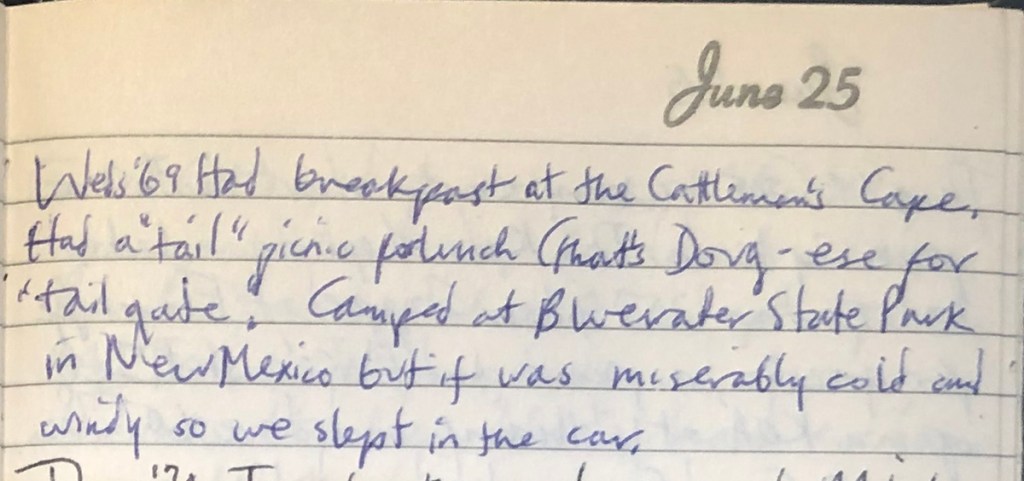
Note Mom’s amusement (nay, astonishment!) at me coining terms like “tail” instead of tailgate. What a little marketer.

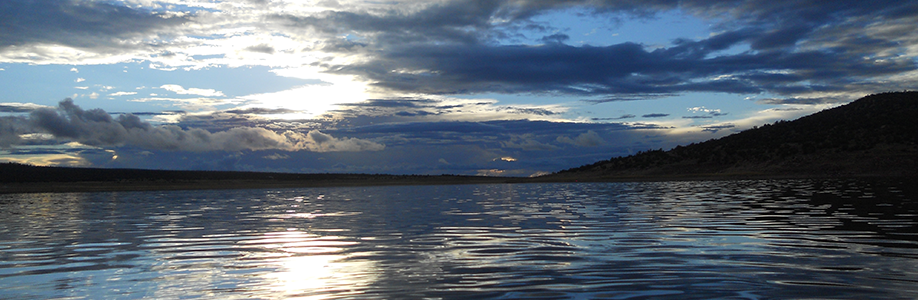
I’m seeing a pattern here: Every place we stopped seemed to have abundant fishing opportunities.

Here’s some more about Bluewater State Park.
July 17, 1969: Trip Lit = Lit Trip

Feels like the blog needs a little tap on the gas. Might be that all those hippies got us digging our mellow.

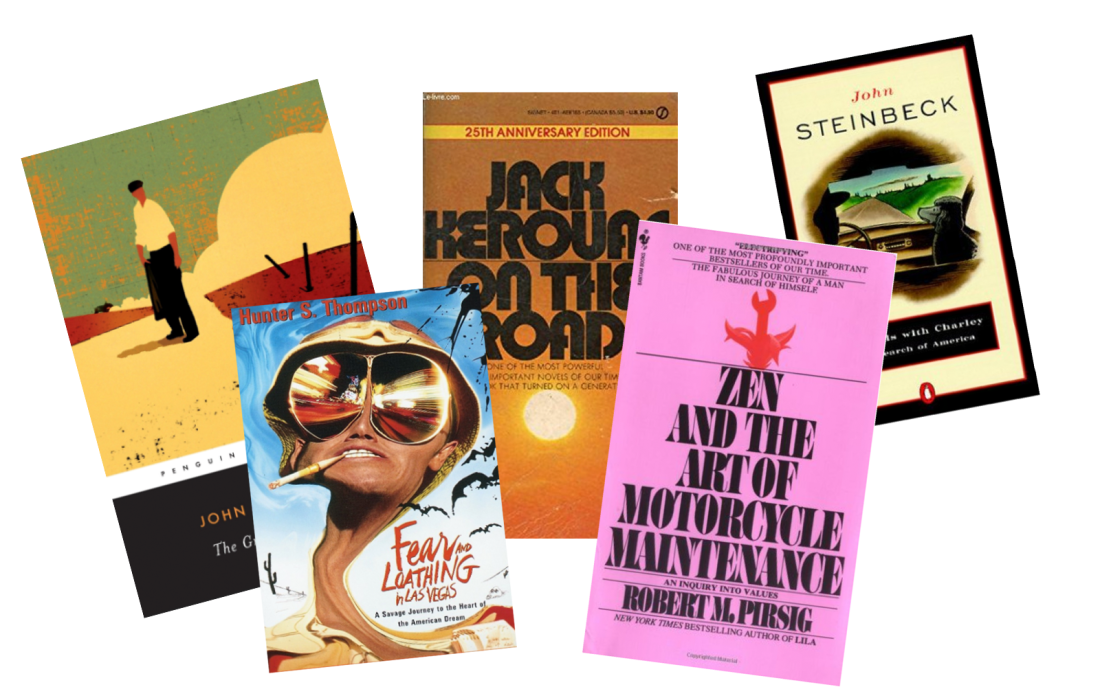
Earlier I covered some of the diversions we had for long days in the car, one of which was Tim reading aloud from John Steinbeck’s Travels with Charley. Even though we’re a little north of Steinbeck country by now, it got me thinking about some of the other books about roadtrips.

Of course, first we need to agree on what constitutes a roadtrip. Does any quest like The Hobbit suffice? The Odyssey? Huck Finn? I’m going to limit it to books that center on a motorized vehicle and the surfaces laid down for them. That’s going to constrict the scope a bit. But hey, I haven’t read that many books about roadtrips anyway, as you’ll see.

Five Favorite Books About Roadtrips

First off: Honorable Mention goes to Mom’s diary from the 1969 roadtrip. Friends and followers have praised her terse but comprehensive style as of “Hemingway.” Had she not documented the trip on a daily basis (no doubt a task past exhaustion most nights), this retracing would not have been possible or even conceivable. Thanks to her for allowing me to use it as the basis for this 50th anniversary project.

5. Travels with Charley, John Steinbeck. 1960

I jumped on the Steinbeck wagon after reading The Grapes of Wrath in middle school. Travels with Charley featured less angst than Grapes, and a dog. To a nerdy high schooler living in the suburbs in the early 80s, this book made solitude seem like a reward (and I was so winning!). Of course, a lot of us were craving “freedom” at that age; the open road, adventure and experience sounded pretty good. I got the impression from Charley that Steinbeck wasn’t looking for that anymore. That’s why this was not my favorite of Steinbeck’s and, for all the catharsis, I’ve heard it was not a favorite of his either.

Get a copy

4. Fear and Loathing in Las Vegas, Hunter S. Thompson. 1971

I didn’t read it. I tried, I really did. But I never found a way in. Same with Tom Wolfe’s Electric Kool-Aid Acid Test. Yep, feels good to admit it. Perhaps I’ll start another blog of all the other staples and classic literature I didn’t read. First up: Infinite Jest by David Foster Wallace. If anyone actually made it all the way through that behemoth, I’d love to hear what it’s about.

Go on, YOU read it!

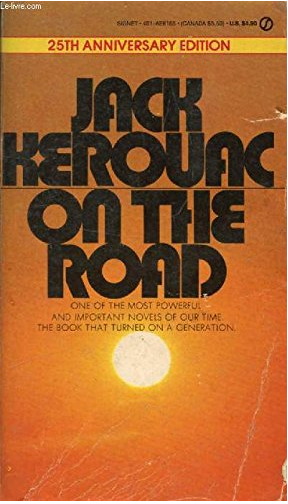
3. On The Road, Jack Kerouac. 1957

Kerouac wrote the book on, well, roadtripping books. Reading it was an exhausting rite of passage, as most Beat books were, forcing you to wake up, get hip and keep up. It reads like the kind of frenzied work that went into it: three nico-caffeinated weeks typing on one continuously scrolling piece of paper. It oozed with the restless angst that Charley didn’t.

In the end, after all of the drama and adventure, the road leads nowhere and nothing really matters.

“‘Where we going, man?’
‘I don’t know but we gotta go.’โ€

And that’s the beautiful thing, man. Dig it!

Read it here.

2. The Grapes of Wrath, John Steinbeck. 1939

This book made me proud to have read it. Steinbeck was a master of restless dreaming, of seeking out a better life somewhere, someday. Of course, it doesn’t work out that way. It’s the journey that helps us arrive at who we really are. Okay, enough psycho babble. The Joads got a raw deal, and the raw deals kept coming everywhere they turned. There’s plenty of political and social symbolism (and the reality of migration, xenophobia, desperation and human nature) in here, but I always come back to this: Tom Joad was an idiot. I’m sure not everyone would agree.

Get you copy here!

1. Zen and the Art of Motorcycle Maintenance, Robert Pirsig. 1974

This was an assignment for a sociology class during college May session, and it changed my summer and my life. For one thing, it made me a pretentious ass — or, rather, it made me aspire for pretentious assiness. Example: the word chautauqua. For years (and even a recently as last month) I will refer to some occasions five or more people are chatting as a chautauqua. Someone needs to break an acoustic guitar over my head.

After 30 years, a few symbols still resonate with me from this book — forgive the brevity:

  • The road is time: the past, future and the present. Be conscious of which is most important at any given moment.
  • The motorcycle represents one’s life: there is the right way to make it work, and there are other ways. Seek out what is the right way for you. Understand the machine well enough so that when it acts up, you are able to make it right again.
  • “Helmets” (while a good idea, I suppose) prevent us from fully experiencing the world around us. Remove it and see the world with better clarity, feel the wind and breathe it in, and savor the nits and gnats as you encounter them along the way.

What really took me in was the indefinable matter of values and quality that we are immersed in everyday. At age 20, this was an epiphany. The prologue is a grabber:

“What is good, Phaedrus, and what is not good, Need we anyone to tell us these things?”

As for Phaedrus, I still spar my own Phaedrus every day. I’m happy to observe that with age comes wisdom, and so my Phaedrus and I have arrived at a healthy entente.

I encourage you all to meet, know and feed your own Phaedrus.

Really, you should read it.


Though the events of these books are a far cry from Mom’s July 17, 1969 — the laundry and Mike’s shot — I’ll bet she learned a lot about all of the above that summer.

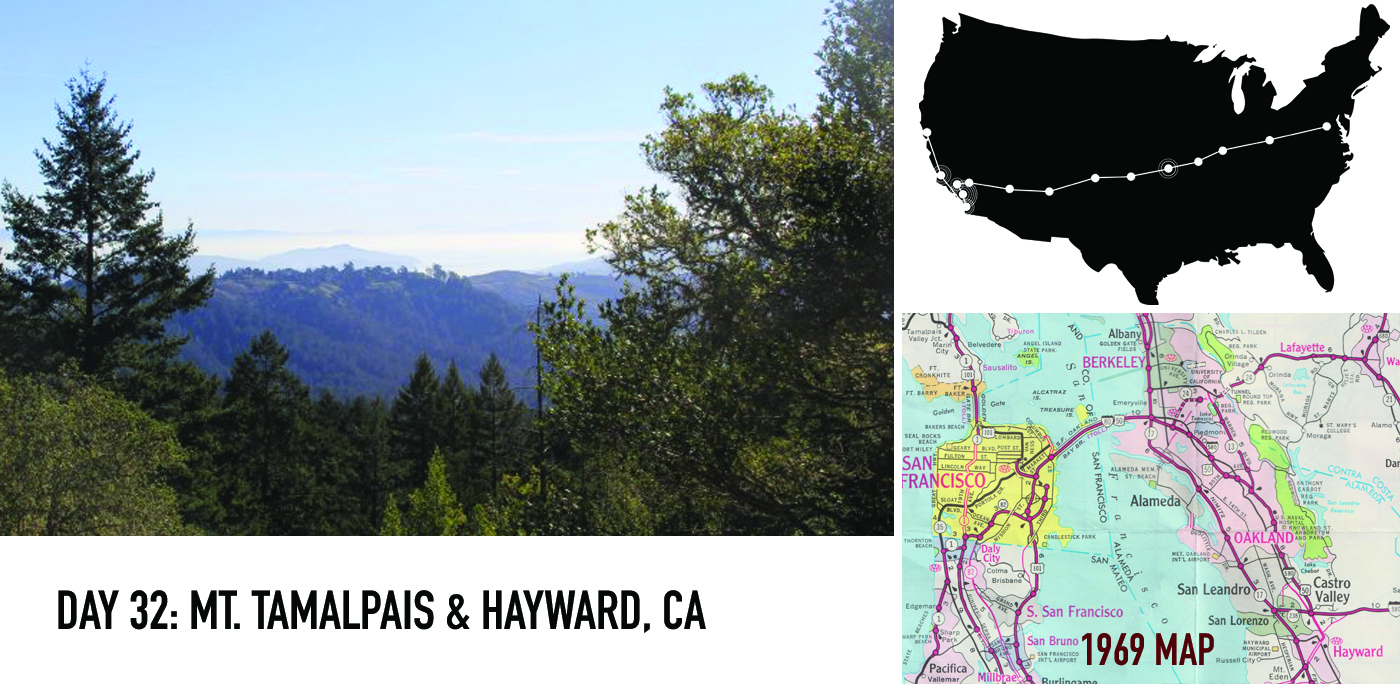
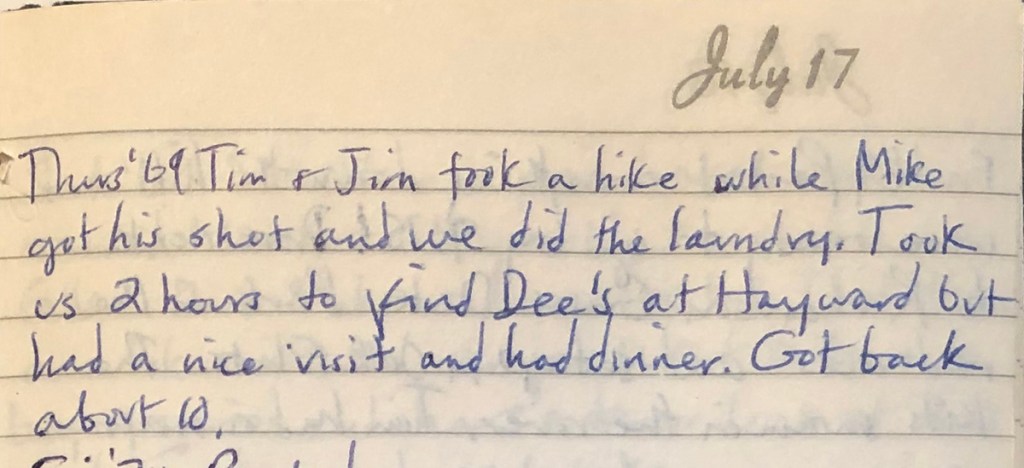
Tim & Jim took a hike while Mike got his shot and we did the laundry. Took us 2 hours to find Deeโ€™s at Hayward but had a nice visit and dinner. Got back about 10.

Marge Binder, July 17, 1969

I’ve been living in the Bay Area for 12 years and have yet to visit Mt. Tam or Hayward. I’m not really proud of that. But there it is.