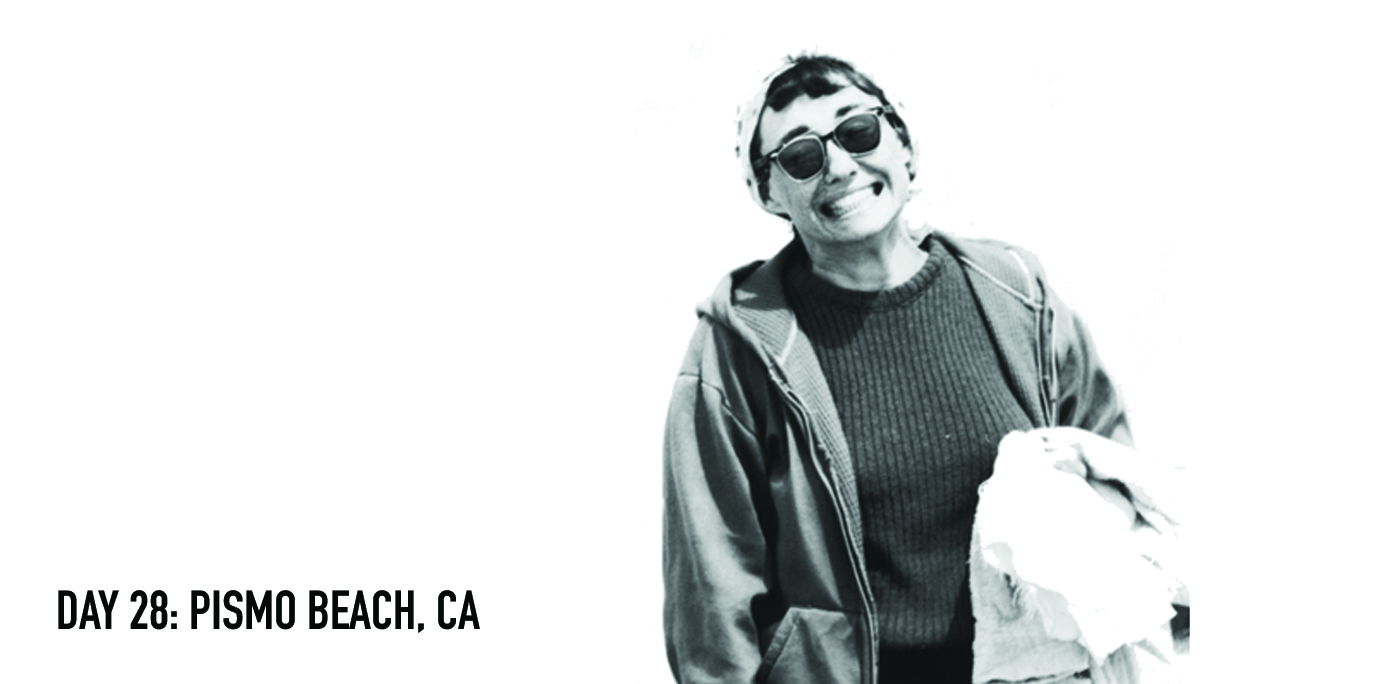
Dad took the photo of Mom on Pismo Beach 50 years ago. It is my favorite and a family treasure. It captures what Mom must have been feeling after four weeks in the car with three boys and a tent. When I think about her looking at Dad behind his camera, she was definitely having a real moment: funny, exasperated, resigned, authentic. And, of course, she’s beautiful!
Every Christmas Eve almost ’til his passing, Dad would put together a slide show, usually four or five carousels full of his latest photos and the classics. When this one hit the screen — which it did every single year — the room would light up. Oohs and aahs and hoots and whistles. Even now, it lights up my day
More normal—cold. Rented a spot at the deluxe campground and they swam in the pool and we all took showers. Jim and I walked up the beach.
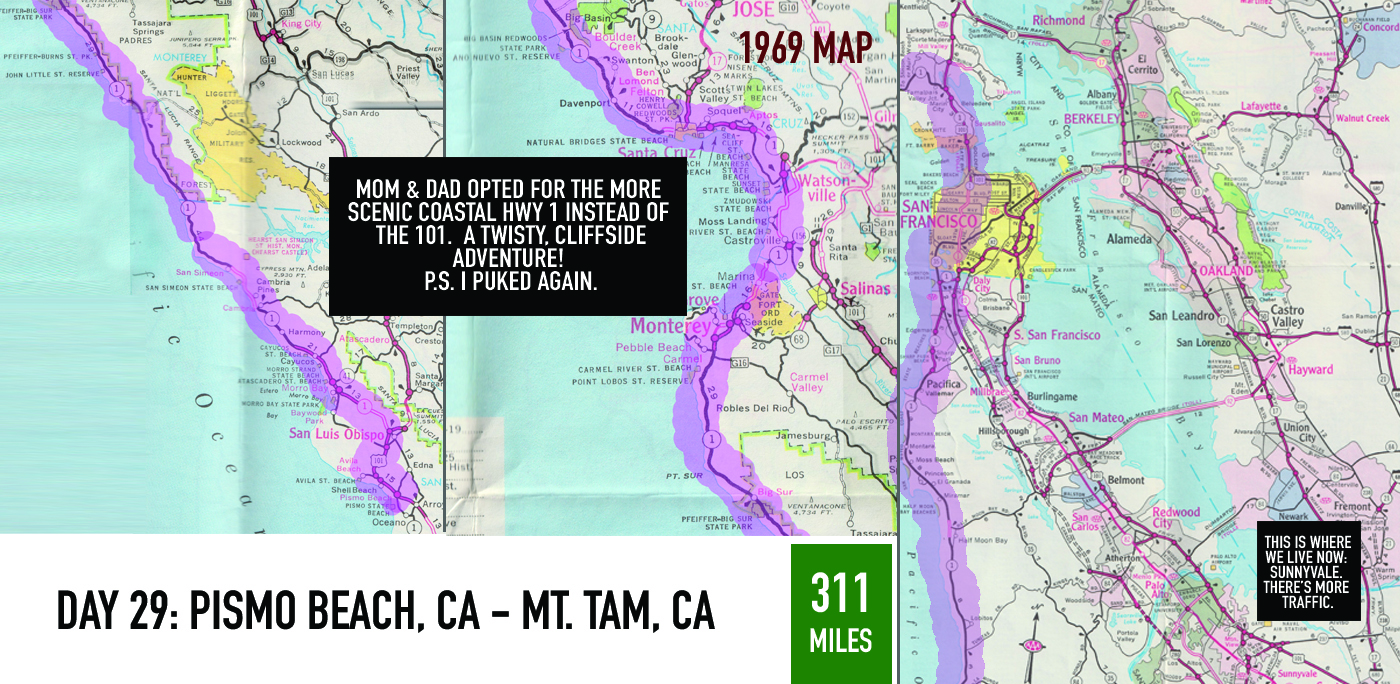
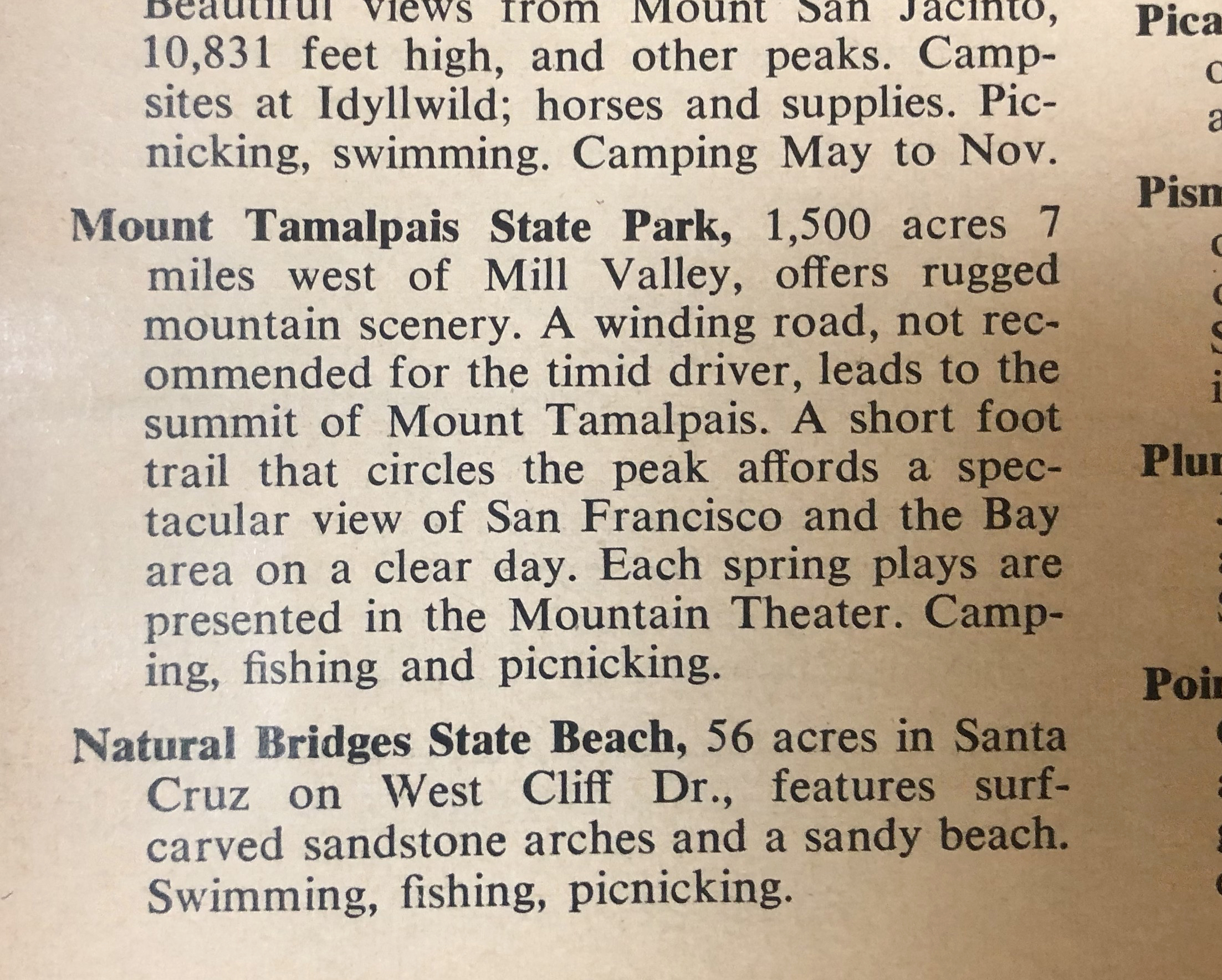
This must have been a spectacular drive along the coast; it is indeed “scenic.” We passed within a few miles of where I live today. In fact, in one of the earliest posts in this blog I cited Interstate 280 as being among the most scenic and sinuous of highways. But back in 1969, it wasn’t yet finished. So up Highway 1 we traveled, along its twisty, hilly, white knuckle contours overlooking the Pacific. (Note in the AAA guide book: the roads are “not recommended for the timid driver.”)
So when it recently come to light that I spent the day with a bucket in my lap, I can’t say I was surprised, given my track record with projectile car-sickness.
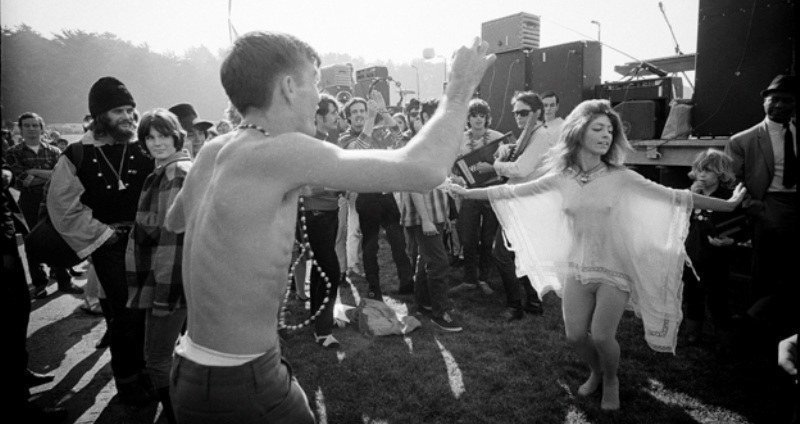
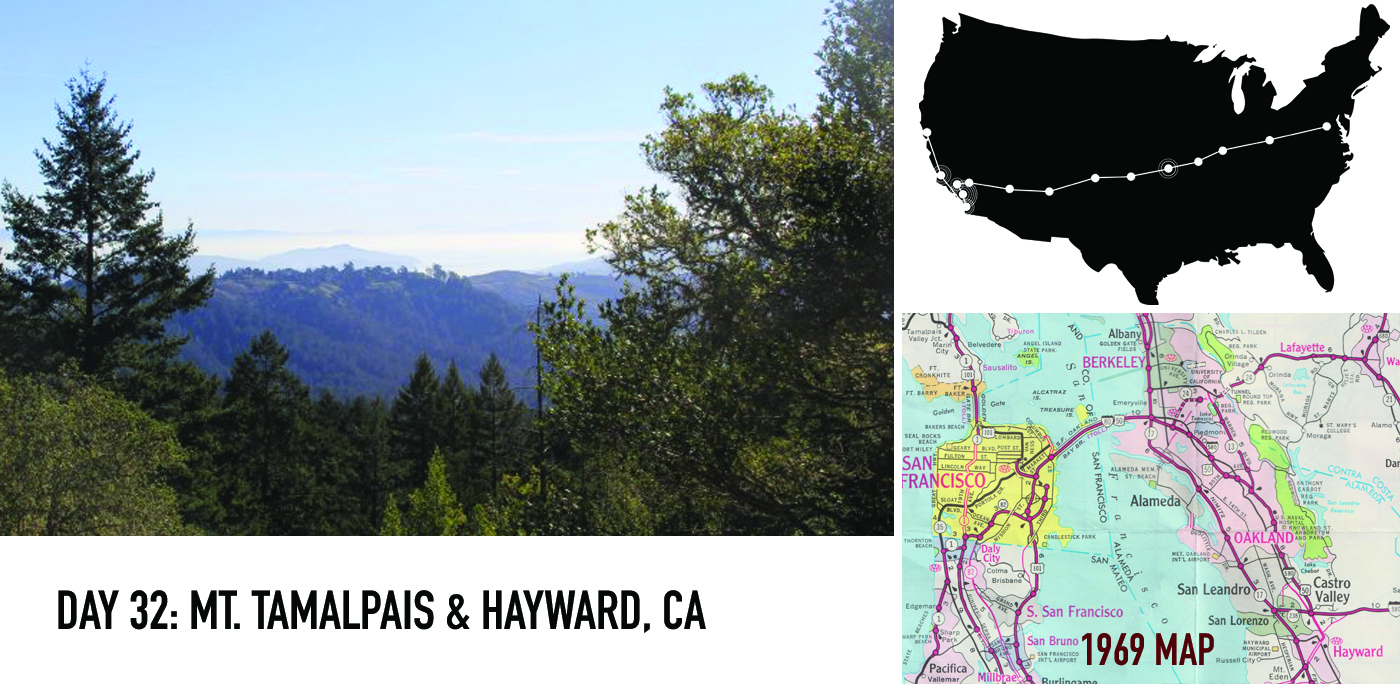
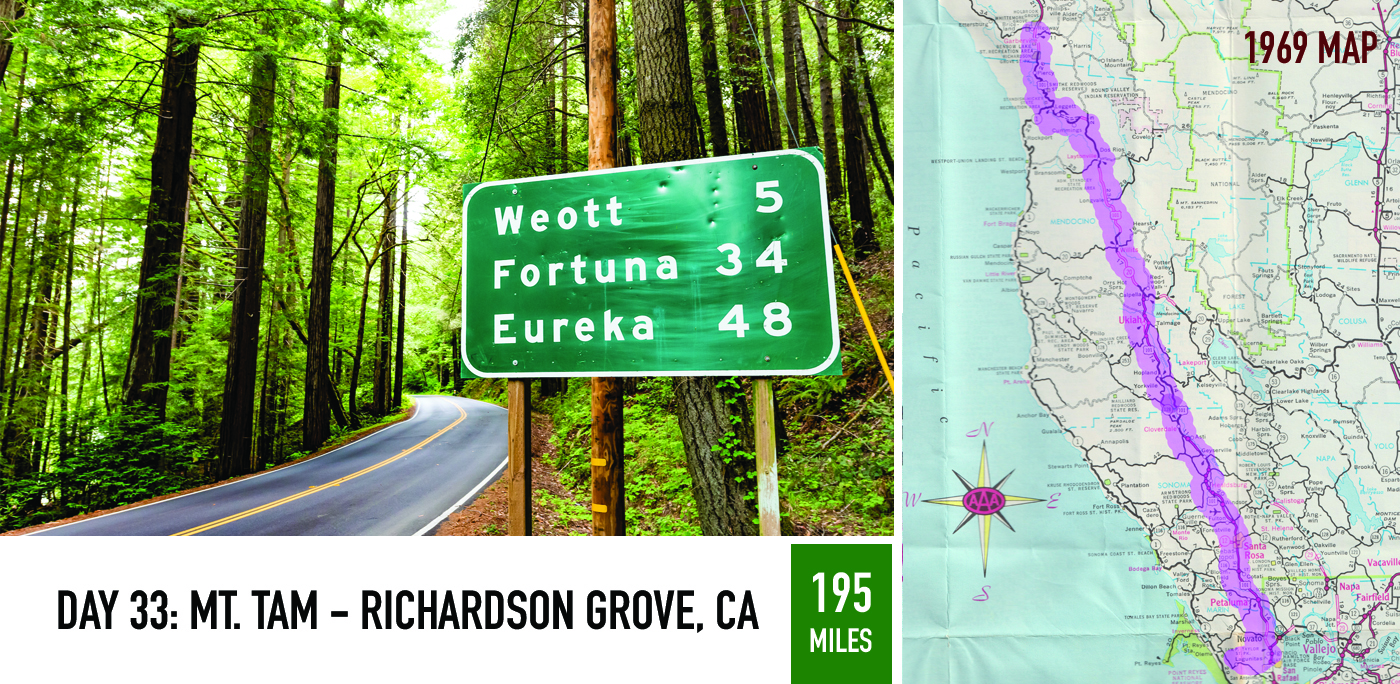
By the end of the day, we were ensconced on Mt. Tamalpais north of San Francisco, communing with hippies!
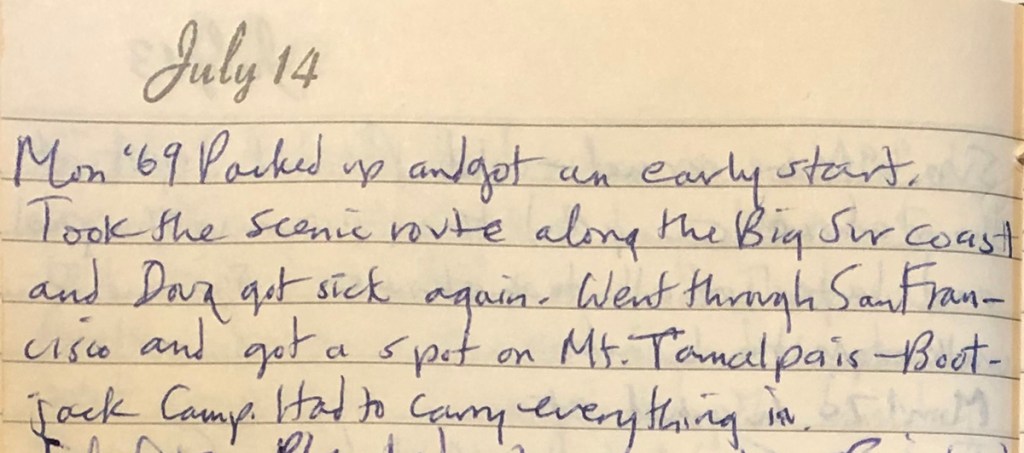
Packed up and got an early start. Took the scenic route along the Big Sur coast and Doug got sick again. Went through San Francisco and got a spot on Mt. Tamalpais—Bootjack Camp. Had to carry everything in.
Before we get to the hippies, there’s another thing that happened this day. I got separated from the family at Fishermann’s Wharf. I have visual memories of the terror: strange crowds and cars and noise and movement in every direction; and no Mom! Maw says she was equally freaked.
We were reunited soon enough because I followed my parents’ advice: “If you get lost, just stay put and we’ll find you.” Or maybe they taught me that after this episode. Anyway, it makes sense.
Hippies were everywhere by 1969, but the Bay Area was still the epicenter of the peace and love action. They seemed nice enough to me, a little dirty and odiferous. For Dad, though, hippies represented a culture counter to his own. He was an establishment man and a veteran of WWII. As the editor-in-chief of ARMY magazine, he was working with a positive narrative on the events in Vietnam. It’s a topic we hashed out many years later; much to my fascination, Dad was both clear-eyed and clear of conscience.
And for all his disparagement, I think Dad liked being around them at Bootjack. I think he found them fun-loving and non-threatening.
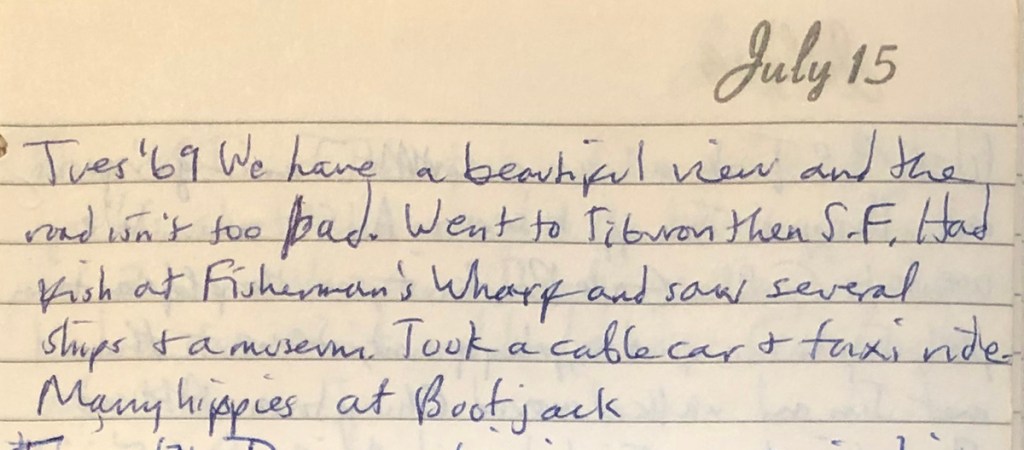
We have a beautiful view and the road isn’t too bad. Went to Tiburon and then S.F. Had fish at Fisherman’s Wharf and saw several ships & a museum. Took a cable car & taxi ride. Many hippies at Bootjack.
Marge Binder, July 15, 1969
Dad also liked to recount an event from this day that Mom glosses over in her diary. As he tells it, we were preparing to jump aboard a cable car. While he waited for one to slow, he saw Mom in his periphery hop aboard the runner with me dangling from one arm. Somehow he managed to get aboard, along with Tim and Mike
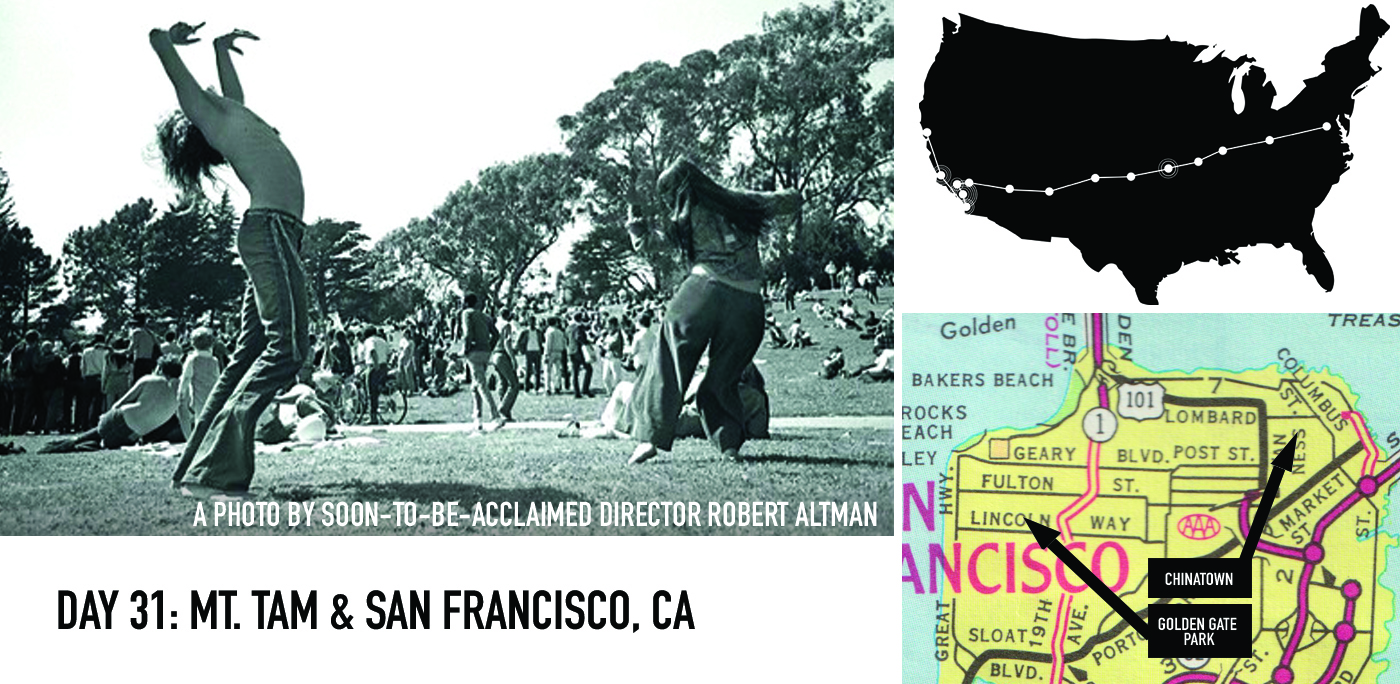
Took a hike around Mt. Tam—gorgeous view. Dropped Jim off to see an AUSA man. We went to Golden Gate Park & saw the fly casting pool, Japanese garden, playground, Sears & then met Jim and walked around Chinatown. Ate at Shanghai Low—Tim had squid. Noisy people in camp.
Marge Binder, July 16, 1969
Mom’s post speaks for itself: a pretty full day. A hike on Mt. Tam, dropping Dad somewhere, hitting several different areas of GG Park, dealing with Sears, dining in Chinatown and returning to a noisy campsite up a mountainside. All with three boys in tow. For Mom it was Wednesday.
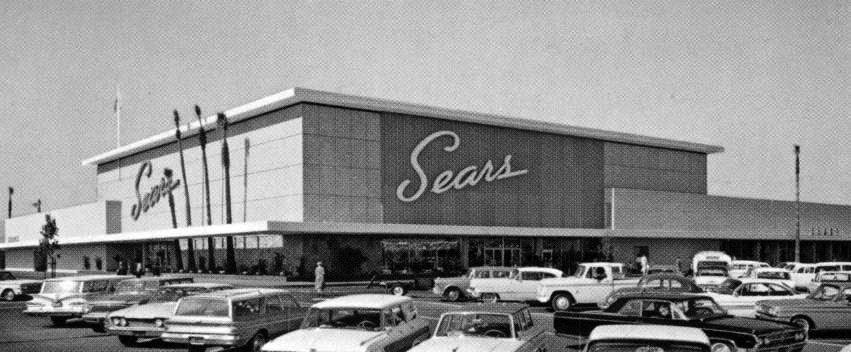
Sears
Mom’s diary contains numerous references to Sears. Rarely though does she detail the needs or transaction. It just seems like an all-purpose reference to procurement and frustration. In one instance she talks about “doing battle” with Sears, which has me imagining her facing down her mortal nemesis, while scoring some new Keds for her youngest.
Feels like the blog needs a little tap on the gas. Might be that all those hippies got us digging our mellow.
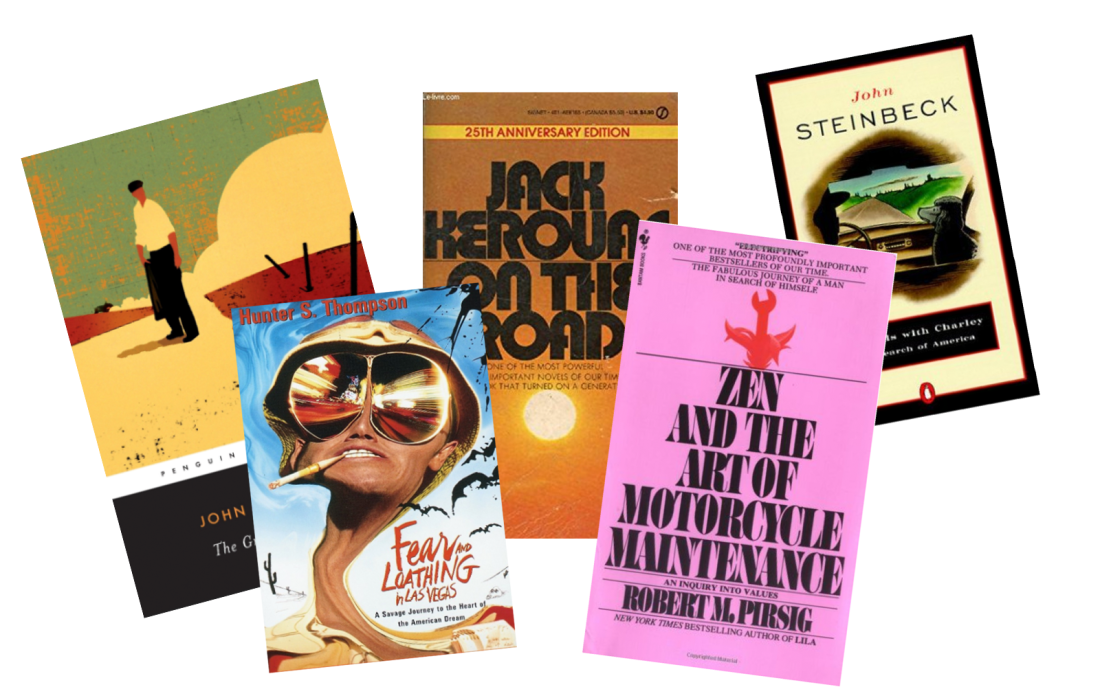
Earlier I covered some of the diversions we had for long days in the car, one of which was Tim reading aloud from John Steinbeck’s Travels with Charley. Even though we’re a little north of Steinbeck country by now, it got me thinking about some of the other books about roadtrips.
Of course, first we need to agree on what constitutes a roadtrip. Does any quest like The Hobbit suffice? The Odyssey? Huck Finn? I’m going to limit it to books that center on a motorized vehicle and the surfaces laid down for them. That’s going to constrict the scope a bit. But hey, I haven’t read that many books about roadtrips anyway, as you’ll see.
Five Favorite Books About Roadtrips
First off: Honorable Mention goes to Mom’s diary from the 1969 roadtrip. Friends and followers have praised her terse but comprehensive style as of “Hemingway.” Had she not documented the trip on a daily basis (no doubt a task past exhaustion most nights), this retracing would not have been possible or even conceivable. Thanks to her for allowing me to use it as the basis for this 50th anniversary project.
5. Travels with Charley, John Steinbeck. 1960
I jumped on the Steinbeck wagon after reading The Grapes of Wrath in middle school. Travels with Charley featured less angst than Grapes, and a dog. To a nerdy high schooler living in the suburbs in the early 80s, this book made solitude seem like a reward (and I was so winning!). Of course, a lot of us were craving “freedom” at that age; the open road, adventure and experience sounded pretty good. I got the impression from Charley that Steinbeck wasn’t looking for that anymore. That’s why this was not my favorite of Steinbeck’s and, for all the catharsis, I’ve heard it was not a favorite of his either.
4. Fear and Loathing in Las Vegas, Hunter S. Thompson. 1971
I didn’t read it. I tried, I really did. But I never found a way in. Same with Tom Wolfe’s Electric Kool-Aid Acid Test. Yep, feels good to admit it. Perhaps I’ll start another blog of all the other staples and classic literature I didn’t read. First up: Infinite Jest by David Foster Wallace. If anyone actually made it all the way through that behemoth, I’d love to hear what it’s about.
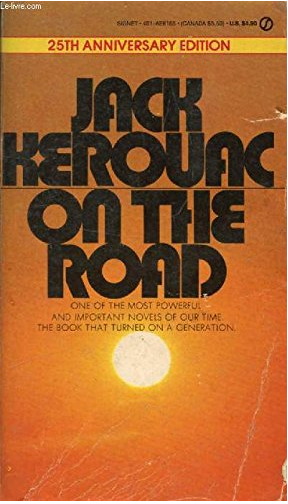
Kerouac wrote the book on, well, roadtripping books. Reading it was an exhausting rite of passage, as most Beat books were, forcing you to wake up, get hip and keep up. It reads like the kind of frenzied work that went into it: three nico-caffeinated weeks typing on one continuously scrolling piece of paper. It oozed with the restless angst that Charley didn’t.
In the end, after all of the drama and adventure, the road leads nowhere and nothing really matters.
“‘Where we going, man?’ ‘I don’t know but we gotta go.’”
This book made me proud to have read it. Steinbeck was a master of restless dreaming, of seeking out a better life somewhere, someday. Of course, it doesn’t work out that way. It’s the journey that helps us arrive at who we really are. Okay, enough psycho babble. The Joads got a raw deal, and the raw deals kept coming everywhere they turned. There’s plenty of political and social symbolism (and the reality of migration, xenophobia, desperation and human nature) in here, but I always come back to this: Tom Joad was an idiot. I’m sure not everyone would agree.
1. Zen and the Art of Motorcycle Maintenance, Robert Pirsig. 1974
This was an assignment for a sociology class during college May session, and it changed my summer and my life. For one thing, it made me a pretentious ass — or, rather, it made me aspire for pretentious assiness. Example: the word chautauqua. For years (and even a recently as last month) I will refer to some occasions five or more people are chatting as a chautauqua. Someone needs to break an acoustic guitar over my head.
After 30 years, a few symbols still resonate with me from this book — forgive the brevity:
The road is time: the past, future and the present. Be conscious of which is most important at any given moment.
The motorcycle represents one’s life: there is the right way to make it work, and there are other ways. Seek out what is the right way for you. Understand the machine well enough so that when it acts up, you are able to make it right again.
“Helmets” (while a good idea, I suppose) prevent us from fully experiencing the world around us. Remove it and see the world with better clarity, feel the wind and breathe it in, and savor the nits and gnats as you encounter them along the way.
What really took me in was the indefinable matter of values and quality that we are immersed in everyday. At age 20, this was an epiphany. The prologue is a grabber:
“What is good, Phaedrus, and what is not good, Need we anyone to tell us these things?”
As for Phaedrus, I still spar my own Phaedrus every day. I’m happy to observe that with age comes wisdom, and so my Phaedrus and I have arrived at a healthy entente.
I encourage you all to meet, know and feed your own Phaedrus.
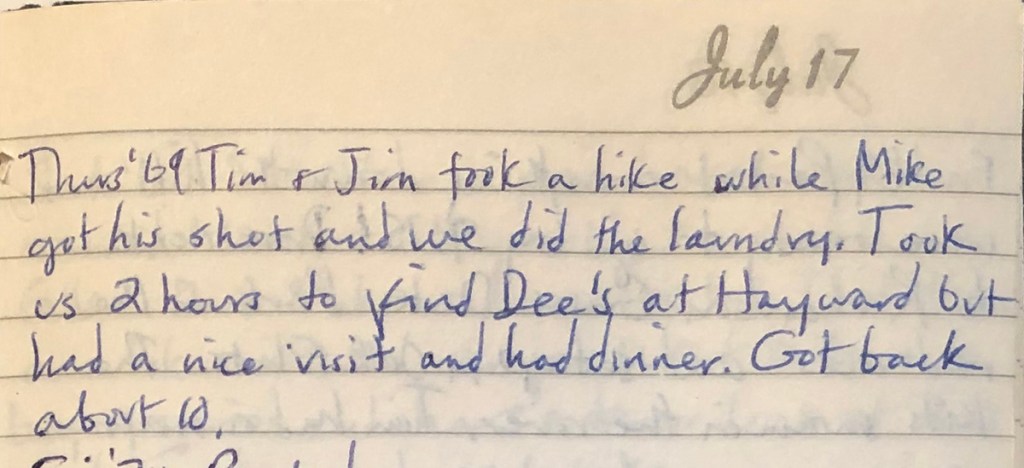
Though the events of these books are a far cry from Mom’s July 17, 1969 — the laundry and Mike’s shot — I’ll bet she learned a lot about all of the above that summer.
Tim & Jim took a hike while Mike got his shot and we did the laundry. Took us 2 hours to find Dee’s at Hayward but had a nice visit and dinner. Got back about 10.
Marge Binder, July 17, 1969
I’ve been living in the Bay Area for 12 years and have yet to visit Mt. Tam or Hayward. I’m not really proud of that. But there it is.
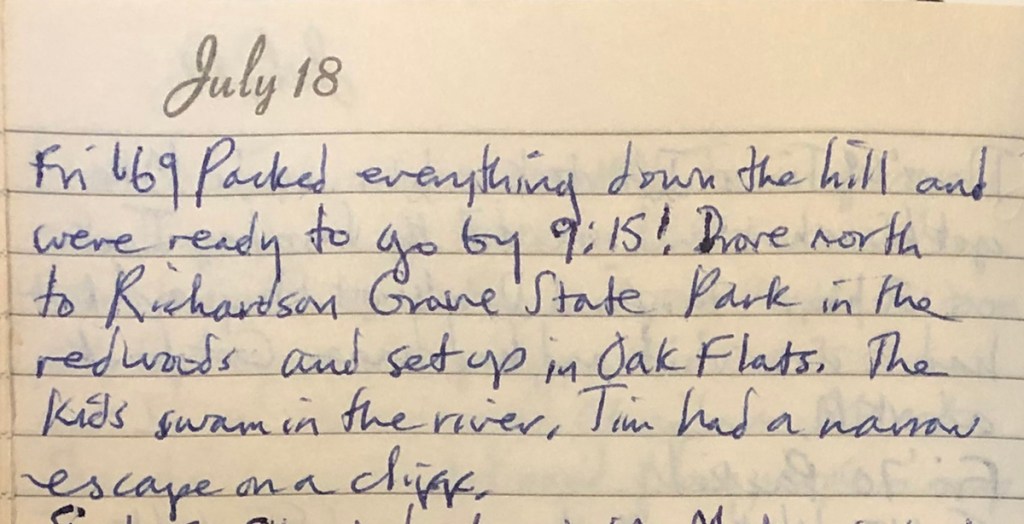
Packed everything down the hill and were ready to go by 9:15! Drove north to Richardson Grove State Park in the redwoods and set up in Oak Flats. The kids swam in the river. Tim had a narrow escape on a cliff.
Marge Binder, July 18, 1969
I checked with Maw recently about Tim’s “narrow escape.” She laughed and assured me that “that happened all the time.” Tomorrow we delve deeper into that topic.
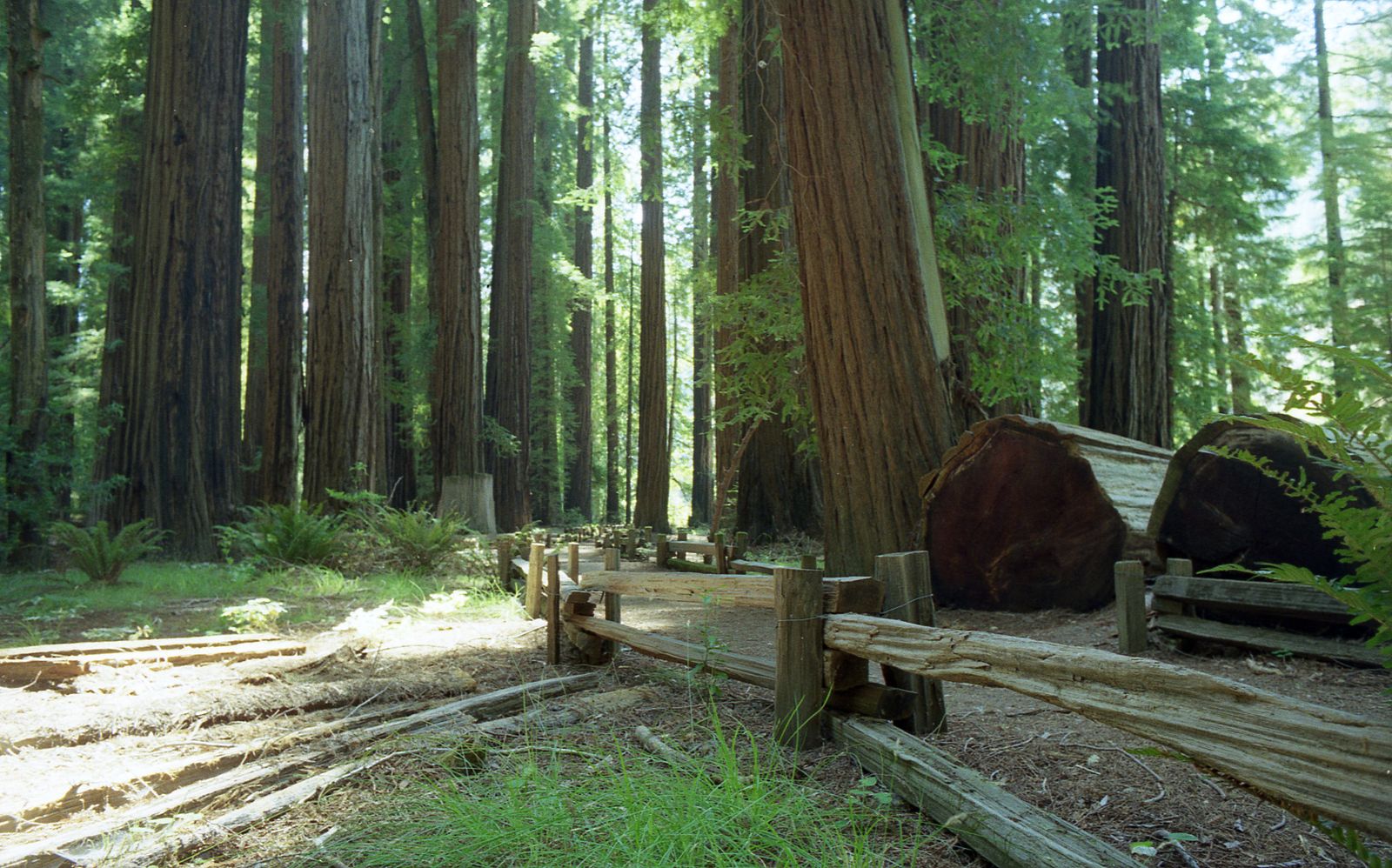
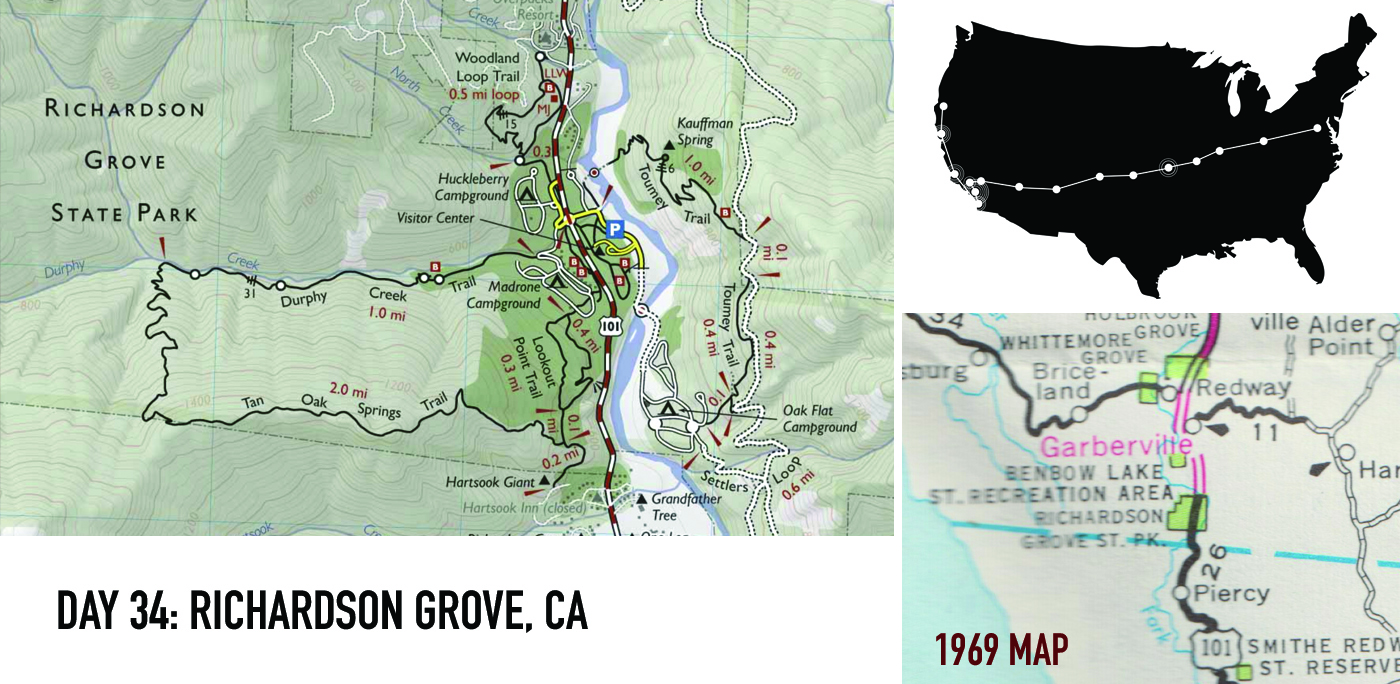
Mom made full advantage of state parks along the way, opting for their modicum of luxury for a discounted fee or even none at all.
Richardson Grove looks to be an idyllic example with all of the right ingredients: rugged terrain, a swimmable river, robust flora and fauna (a stray dog tried to bite Mike), all set amidst the mighty redwoods.
Did you know there are now over 8,500 state parks in the country? Here’s a recent article all about state parks from The New York Times.
Ever think of becoming a park ranger? (I think you know who I’m talking about.) Here’s a good site to get started.
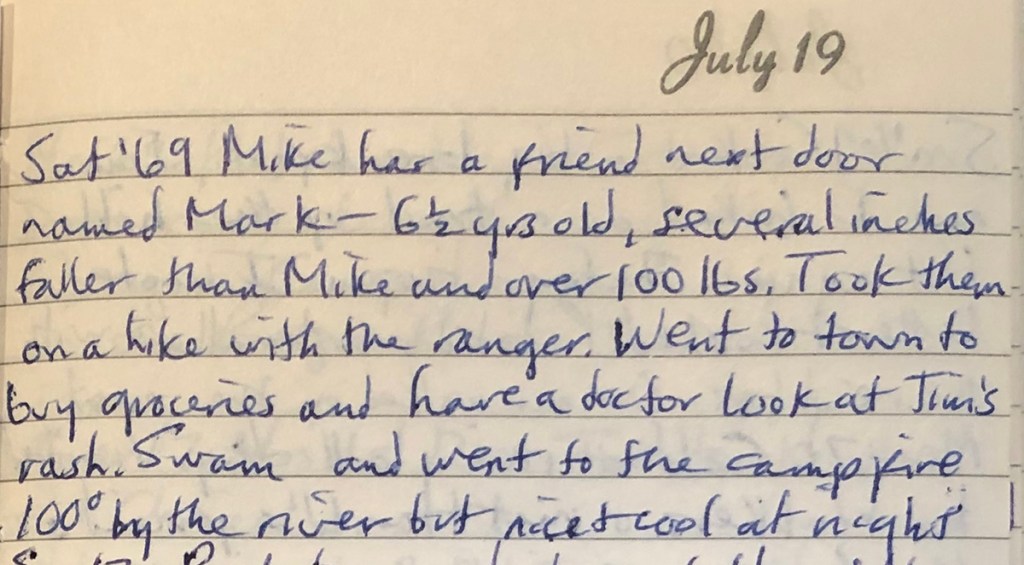
Mike has a friend next door named Mark—6 ½ yrs old, several inches taller than Mike and over 100 lbs. Took them on a hike with the ranger. Went to town to buy groceries and have a doctor look at Tim’s rash. Swam and went to the camp fire. 100° by the river but nice & cool at night.
Marge Binder, July 19, 1969
Okay, I’ll admit the headline “Tim Sees a Doctor” seems a little unexceptional. Thing is, it’s huge. Tim avoided doctors his whole life, so I don’t think he went willingly back in 1969, especially for a measly rash.
In his life, Tim experienced several injuries that would require anything from stitches to not-simple surgery. The ones I can remember from the last 20 years or so: he got bit by a copperhead snake and watched his hand swell and turn black, waiting several days to seek treatment; he dropped a fish-cleaning knife into his foot, severing a major tendon and was goaded by Dad into finally seeing a doctor, only to forego the kind of therapy he needed to heal; a few years before he passed, he twisted his knee in an unfortunate encounter with his car on an icy driveway, so he used a cane from then on rather than get help.
That was Tim, and he was proud of it.
In the book we made for our parents’ 60th anniversary, Tim contributed an essay about one of these doctor-avoidance episodes, something I called “Medical Attention Deficit Disorder.” Here is an excerpt:
Until the last few years, fish-cleaning was done on a makeshift table in the garage. In 2002, I was butchering a bountiful day’s catch with a murderous and electric fish-fillet knife. Between salmon, this implement fell — while switched on — off the table and onto my right instep, slicing a tendon neatly in two, and causing blood to gush. It also caused a vocal argument between Boss, who advised a trip to the emergency room, and I, who wanted to wrap it in gauze and duct-tape and go fishing the next morning. As Captain of the ship, Boss’s will prevailed. Besides sutures, the local doctor advised surgical splicing of the tendon, which I declined when told this would keep me off the water for several precious days.
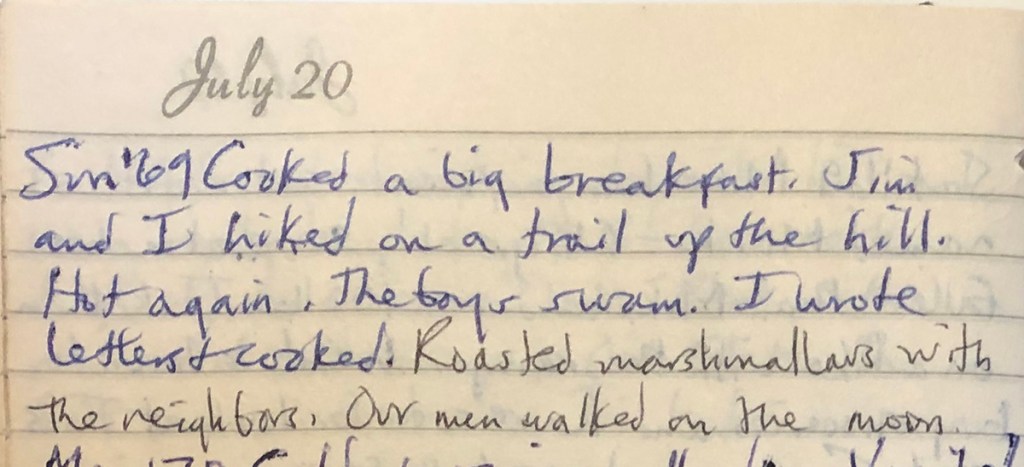
Cooked a big breakfast. Jim and I hiked on a trail up the hill. Hot again. Boys swam. I wrote letters & cooked. Roasted marshmallows with the neighbors. Our men walked on the moon.
Marge Binder, July 20, 1969
Once again, Mom employs few words to tell big stories. It’s the only time during the trip that Mom cites a current event. It was a big one, no doubt, and one that I actually recall.
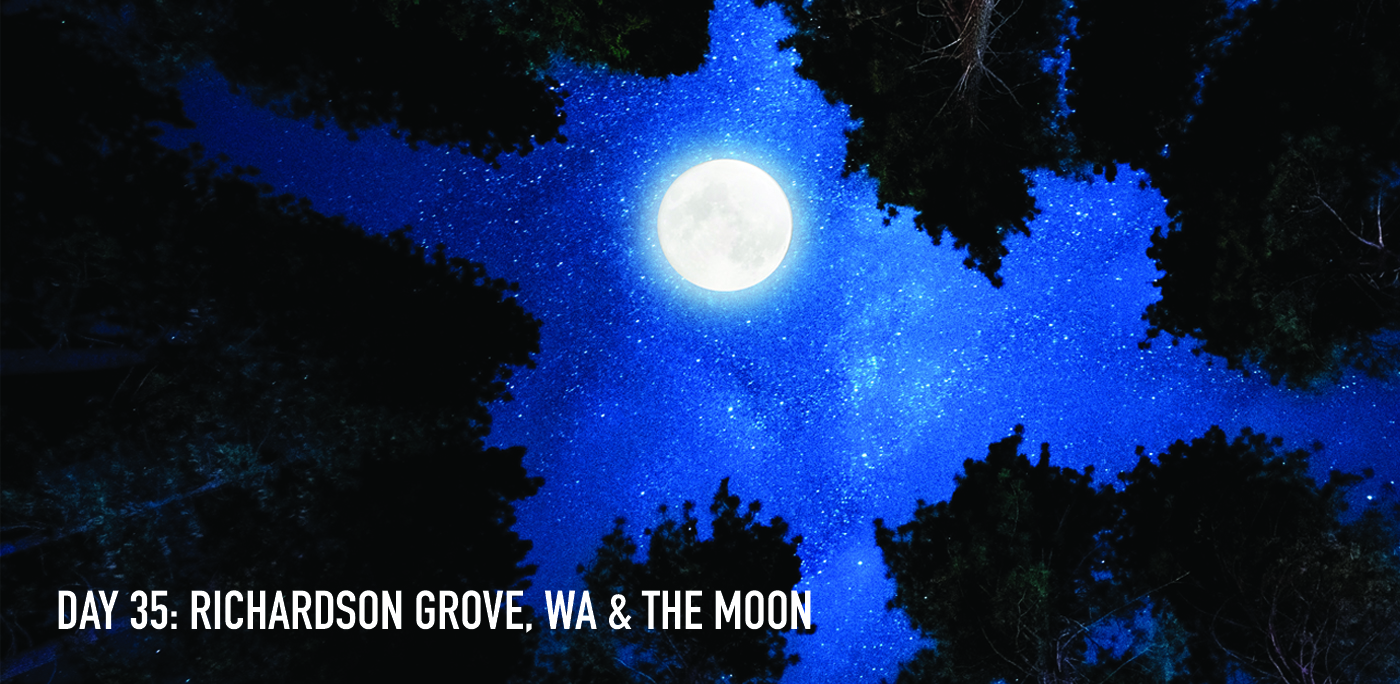
The mental relics I have are of staring up at the moon and being surrounded by lots of people and massive trees. There was music and radio chatter, and everyone seemed a little extra buzzed. Once again, Dad was in the midst of hippies and seemed very contented. All us humans just looking to the sky.
Mom explained to me: “There are men walking on the moon.” I tried really hard to see them (I’m not being cute, I actually tried), but I couldn’t see them. Even so, I believed what Mom was saying, however implausible.
In 1979, 10 years to the day, a buddy and I took the DC Metro downtown to see Neil, Buzz and Michael appear at an anniversary event at the Air & Space Museum. A 14-year-old hanging in the Nation’s Capital standing a few feet from two men whose feet walked on the moon — that was not an atypical day in my youth, thanks to Maw’s encouragement.
Fun story: At the ceremony, the microphone kept failing. Someone in the crowd yelled out, “We can put a man on the moon, be we can’t hear him speak!” Oh, we had a good laugh. Hoo boy. Still gets me.
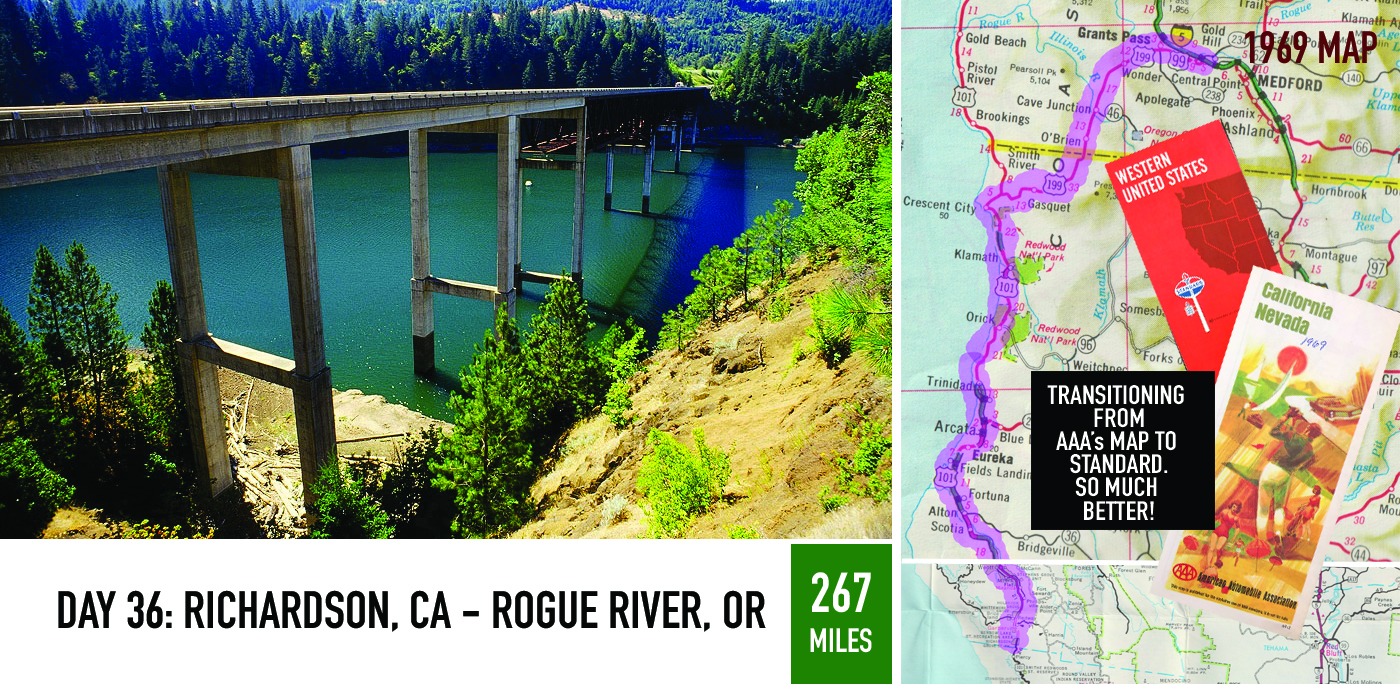
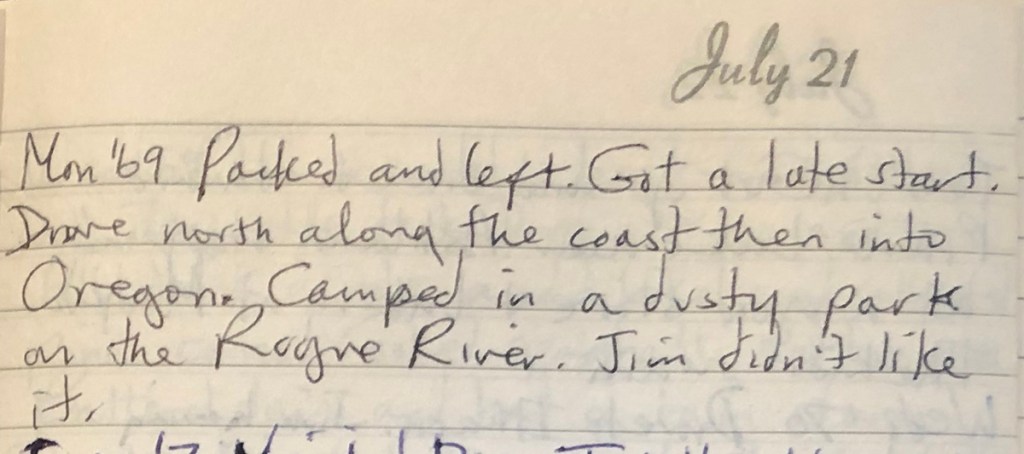
Dad was not a fan of the campsite along the Rogue River. Mom describes it as “dusty.” After all that she had endured on this trip, though, I’m sure she made due.
This occasion would have been ideal for Mom to proclaim her yet-to-be-TM’ed motto: Es mejor que nada. Spanish for, It’s better than nothing. The “baby” was tacked on later, probably during her tenure as a high school Spanish teacher in Fairfax County.
Mom voiced this mantra often in the past 40 years. It’s at the heart of who she is: a Depression baby who appreciates what you have, because it could be worse! Yeah, she was an optimist, a trait I did not inherit.
Years later, I had shirts printed.
Packed and left. Got a late start. Drove north along the coast then into Oregon. Camped in a dusty park on the Rogue River. Jim didn’t like it.
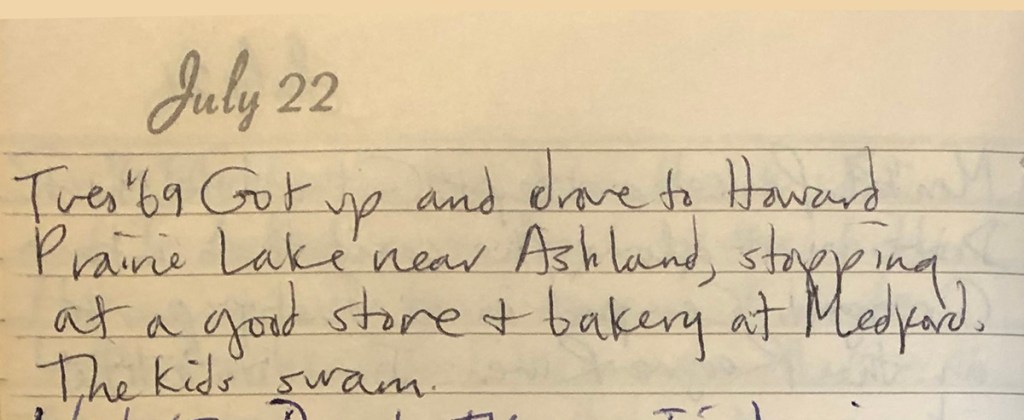
Got up and drove to Howard Prairie Lake near Ashland, stopping at a good store & bakery at Medford. The kids swam.
Marge Binder, July 22, 1969
Could this be the last photo of Tim with his glasses? Maybe.
Mom must have submitted her diary entry before the drama that unfolded later that night. My brother Tim, a gifted raconteur, was holding forth around the campfire after dinner, doing impressions, mimicking the Borscht Belt greats, “owning the room.”
At some point, he slung around and — phwoosh — off flung his glasses into the fire. While we all reacted in horror (and a bit of “what an showman!”), Tim went about trying to retrieve them. But they were already literally toast.
To a Binder boy, lost or broken glasses meant humiliation, like getting a C+ on a test (Tim was the exception to this analogy). Lost glasses was just one more piece of tinder to stoke our raging insecurities. Our childhoods were littered with such spectacles (pun intended), some involving snowball fights, scrapes at school or simple stupidity.
On top of the initial sting of loss, Tim would be blind for a while, until we were someplace long enough for lenses and glasses to be made — pretty much the remainder of the trip.
No matter, it was really funny. Mission accomplished, Timbo! You owned it!
Fun story: When I finally got contact lenses in 1978, I lost one before I even got out of the office. Must have been a sight (puns abound!) for arriving patients to see a half dozen nurses and admins crawling around on the floor.
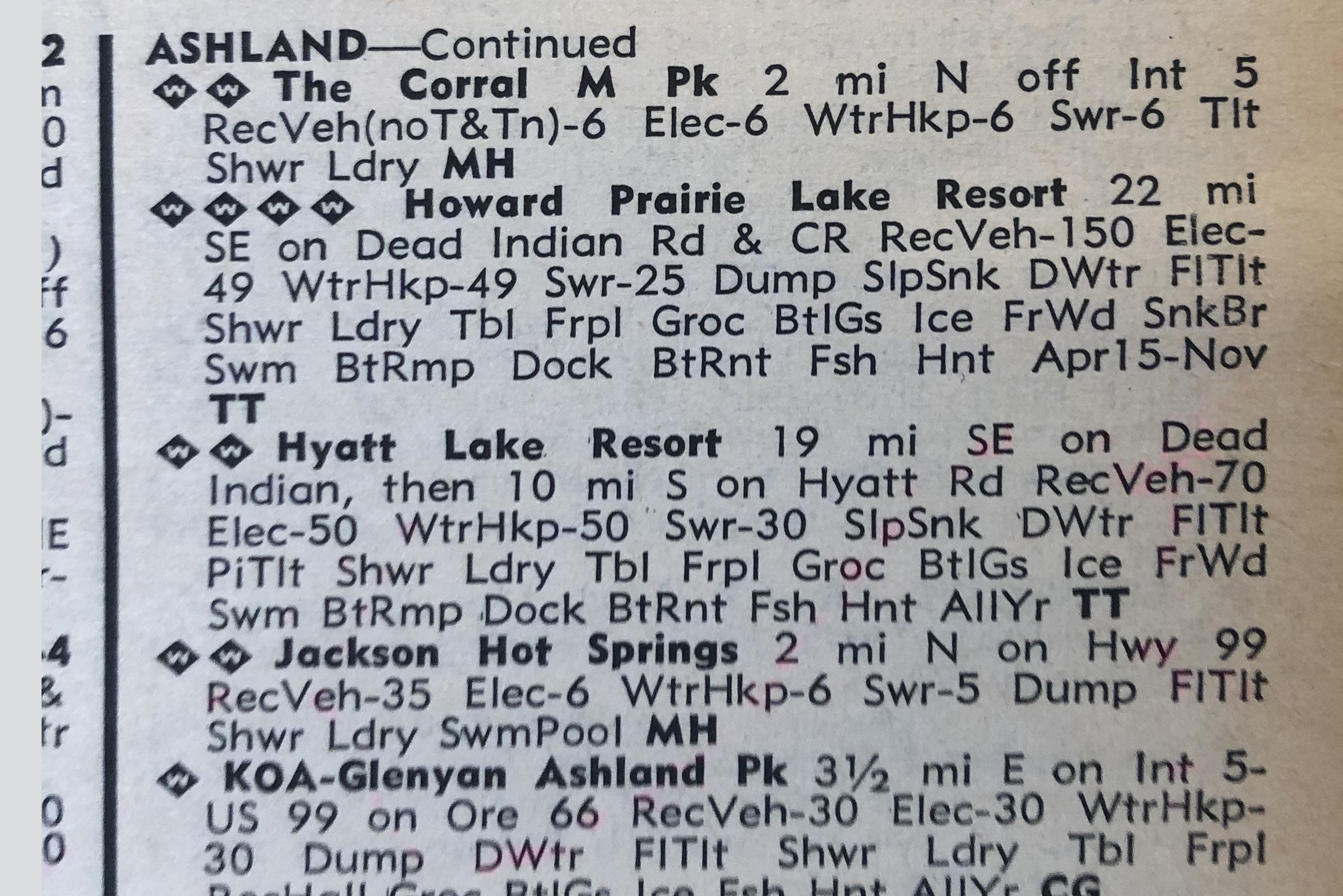
Note the address: Dead Indian Road. Well certainly they’ve changed the name of that by now. Nope. It’s actually got a pretty significant history. You can learn about it here.










 Marge Binder's Epic Adventure
